Table Of Content
The next module is probably the most difficult todesign, so notice that the design defers the "hard parts" until later. Thisallows us to concentrate on the module as a whole, rather than getting lost in details. In the example below, comments about the development of the design are ingreen. Fair enough however what kind of progress reports are required for these students.
Quicker implementation
Although they’re less common in our portfolio of work, there are some scenarios when using a bottom-up approach makes more sense. Thus regenerating large assemblies can bring even fast computers to their knees. Let’s compare top-down design with the more traditional bottom-up approach.
Program Code – Mastering the Art of Top–Down Design in Programming
Harder to write this way, harder to read, can't resuse anything. I tend not to worry about arguments to methods until implementation. Note that I don't worry about details like object constructors at this point. Sometimes a branch maps to a module for which we use a class like a DatabaseManager singleton object. Most often a decomposition diagram path will weave through several objects. Prototyping is like trying on clothes before making a purchase 👗.
How long do toasters last?
When you tell him you’re done, the look of disbelief on your boss’s face is pure gold. Think of top down design as a more holistic view of the product scope. The top-down method forces one to take a broader look, and subsequently getting more detailed; starting at the top with the comprehensive project stipulations, then work down to the details. A little further thought, however, will lead us todiscard this idea.
Understanding Top Down Design in Programming
It must be handled at the design phase so that the implementation is done correctly and performs as expected. For example, in the above list user, course, exams, grades are all different systems on their own. Reports modules will have to interact with all these systems to get the data required for the report. In an eLearning application, generating progress reports for students can be a theme of requirement. First, each function is checked for correct operations with both valid and invalid inputs.
The Designs of Innistrad - Hipsters of the Coast
The Designs of Innistrad.
Posted: Tue, 31 Aug 2021 07:00:00 GMT [source]
Understanding the Basics: Top–Down Design in Programming
One can see the inverse effect that top–down control has in this example; when the population of otters decreased, the population of the urchins increased. You can improve your Top Down Design skills by practicing breaking down complex problems into smaller parts, taking on coding challenges, working on real-world projects, and seeking feedback from experienced programmers. Let’s say you’re tasked with creating a program to calculate the total cost of items in a shopping cart. Using Top Down Design, you would first design the main function to calculate the total cost. Then, you would break it down into sub-functions for adding up item prices, applying discounts, and calculating taxes. If we had a category devoted to the best 4-slice toaster for bagels, the Breville Die-Cast 4-Slice Toaster would win by a landslide.
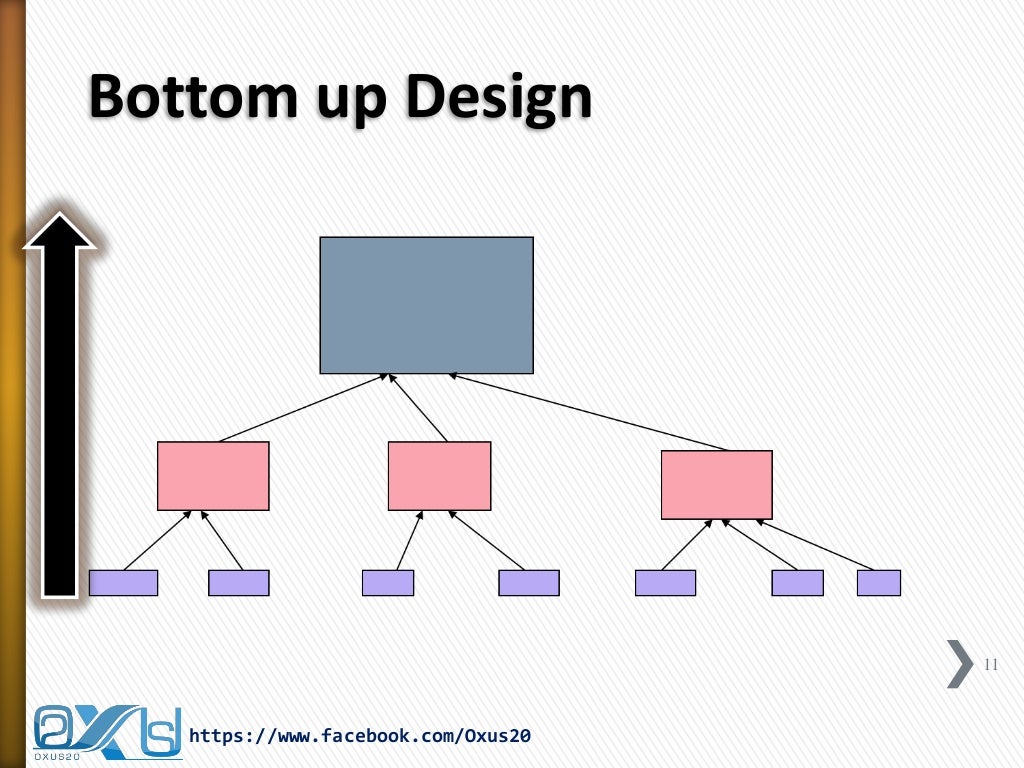
In a bottom–up approach the individual base elements of the system are first specified in great detail. These elements are then linked together to form larger subsystems, which in turn are linked, sometimes at many levels, until a complete top–level system is formed. This strategy often resembles a "seed" model, by which the beginnings are small, but eventually grow in complexity and completeness. Object-oriented programming (OOP) is a paradigm that uses "objects" to design applications and computer programs. Top–down and bottom–up are two approaches for the manufacture of products. Certain valuable nanostructures, such as Silicon nanowires, can be fabricated using either approach, with processing methods selected on the basis of targeted applications.
You start by designing the main function or the big picture first, and then gradually break it down into smaller sub-functions or modules. This code exemplifies the top down design approach in programming, focusing on breaking down large problems into smaller, more manageable functions that address specific parts of the problem. Using Top Down Design, you would first outline the main features like setting reminders, displaying notifications, and managing user preferences. Then, you’d break these down into smaller functions like setReminder(), displayNotification(), and managePreferences(). Since we are in the consulting business, we at M3 Design are acutely aware of the hours spent on every task and are constantly optimizing for efficiency. The time saved in the Concept Phase with a top-down driven design more than compensates for the little bit of time required to remove the master after concept freeze.
IEEE Publishes Comprehensive Survey of Bottom-Up and Top-Down Neural Processing System Design - Synced
IEEE Publishes Comprehensive Survey of Bottom-Up and Top-Down Neural Processing System Design.
Posted: Thu, 10 Jun 2021 07:00:00 GMT [source]
Break functions into smaller chunks
The Breville “A Bit More” Long Slot Toaster is a modern and thoughtfully designed, high-performance appliance with easy cleanup and user-friendly controls. All of the cool features in the best long-slot toaster are available in the Breville Die-Cast 4-Slice Toaster. The main differences are this toaster costs twice as much and has four wide, not long, slots.
When you press the lever down, a timer starts based on the shade you select. Contrary to popular belief, the shade numbers do not correspond to the minutes the toaster will toast. I only tested one long-slot toaster for this guide, the Oster Long Slot 4-Slice Toaster, and it did so poorly with bagels that I disqualified it from future testing. Fortunately, Business Insider contributor Taylor Tobin wrote a whole guide on the best long-slot toasters, and we selected her top pick for this guide.
In Top Down Design, you then define functions for each of your sub-problems. Functions act like specialized tools; they perform specific tasks efficiently. By breaking your code into functions, you maintain clarity, promote reusability, and make debugging a breeze. You'll likely need to splurge on a pricier model if you're after fancy features and designs. A cheaper model will work fine if you just want a good workhorse, though we've found the cheapest toasters just don't pass muster when it comes to toasting evenly and accurately.
All decisions that you take down the line must be mapped back to business goals. To understand top-down design, let’s take an example and do a deep dive. The architecture is simple and can be expanded further with modules for payment processing, shipping, etc. to fully represent an e-commerce system. It encapsulates the principles of top-down design by separating concerns into distinct classes and functions, allowing for ease of understanding, maintenance, and scalability. Let’s say you are tasked with creating a program to calculate the total sales of a store. Using top-down design, you would first outline the main steps such as inputting sales data, calculating total sales, and displaying the result.


No comments:
Post a Comment